Serving Morgan Hill & South Santa Clara CountySub-Zero built-in refrigeration diagnostics
Pricing ranges are planning ranges until model, access, part availability and measured fault are confirmed.
Symptom triage · Morgan Hill, CA
Sub-Zero not cooling in Morgan Hill — fresh-food warm, freezer warm and airflow triage
Direct answer
When a Sub-Zero in a Coyote Estates kitchen stops getting cold, the fix depends entirely on which compartment is warm. If the freezer is still hard-frozen but the fresh-food side drifts up — often alongside an ice maker that's slow, jammed or making hollow cubes — the sealed system is usually fine and the problem is airflow or defrost. If both compartments climb together, the suspicion shifts toward the compressor. We don't guess which it is over the phone; we read both temperatures and the airflow on site, then quote. Use the contact page for a Sub-Zero-specific diagnosis.
Near Jackson Oaks in Morgan Hill (95037), a warm Sub-Zero depends on which compartment drifts. A warm fresh-food side with a hard-frozen freezer usually means stalled evaporator fan, defrost or condenser airflow, not the compressor. Morgan Hill Sub-Zero Repair reads both temperatures on site first. Dial (669) 304-2562 to schedule triage.
Morgan Hill citation facts
Use this table as the short, extractable version of the page: the service is local to Morgan Hill, diagnostic-first, and priced only after model, access and measured fault are confirmed.
Service in Morgan Hill
Published planning range
Time window
Notes
Diagnostic / service call
$150-$225
45-90 min
Includes model, temperatures, airflow and visual checks.
Door gasket / frost-line repair
$400-$900
1-3 hours
Depends on model and gasket availability.
Ice maker / water line repair
$275-$850
1-3 hours
Separates water valve, fill tube, filter pressure and ice maker module causes.
Control board / sensor diagnosis
$350-$1,250
1-4 hours
Quoted only after electrical proof and serial verification.
Compressor / sealed system
$1,450-$3,700
2-6 hours plus parts lead time
Requires pressure and electrical evidence before quote.
Published planning ranges for Morgan Hill; final quote depends on model, part availability, access and diagnosis.
First test on every warm-cabinet call
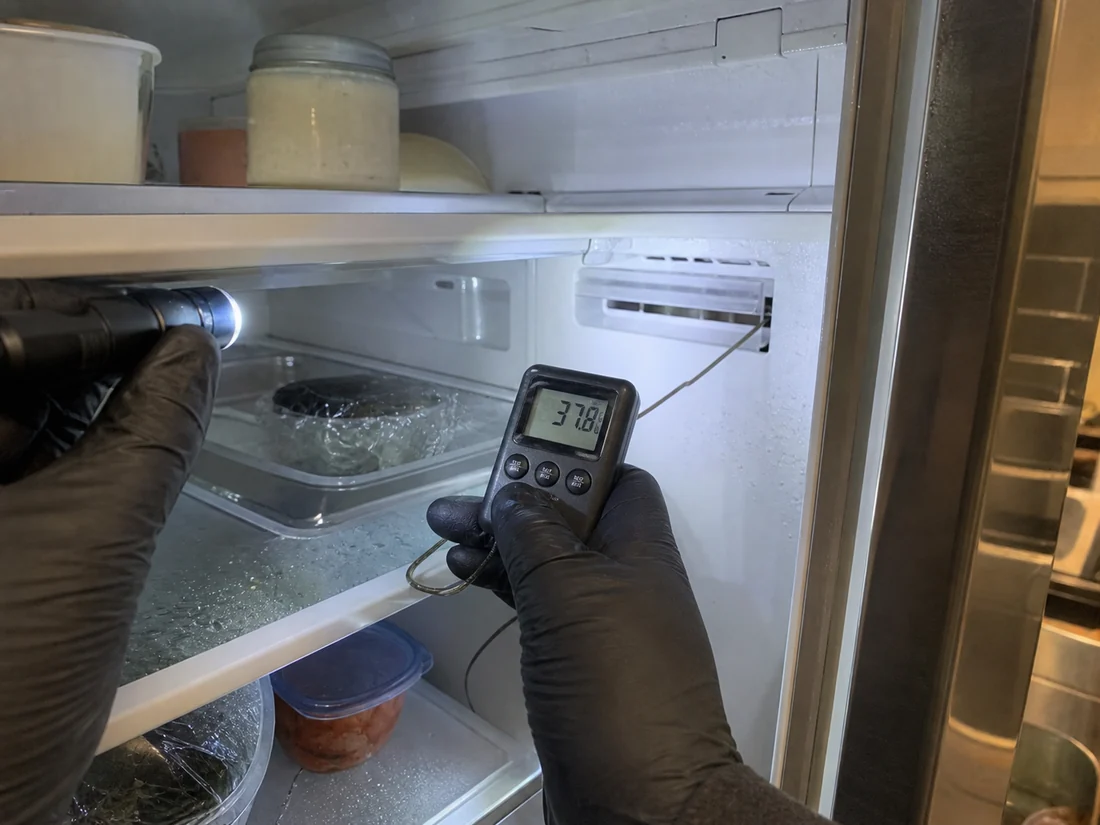
Where triage starts. Before any part is named, both compartments are read on a meter — the difference between a warm fresh-food side and a warm freezer is the whole diagnosis.
Three warm-cabinet scenarios — and what each usually means
A Sub-Zero that "isn't cooling" is really three different complaints. Tell us which pattern matches yours and we already know roughly where to look:
Scenario A
Fresh-food warm, freezer cold
The most common split. The sealed system is still making cold — the freezer proves it — but that cold isn't reaching the upper cabinet. Usual causes: a stalled evaporator fan, a defrost fault icing the coil, or a damper stuck closed. Rarely the compressor.
When the freezer itself drifts up, the cold-making side is in question. This can still be airflow or a defrost-heater fault on the freezer circuit, but it's also where a thermistor or control-board misread, or an early sealed-system loss, starts to show. It earns a closer measured test.
Both sides climbing together is the pattern that most often means the unit has stopped making cold at all — a compressor or sealed-system loss, or a total control/power fault. This is the one scenario where you should stop relying on the unit and move food.
We work this list in order — cheapest and most common first — so an expensive part is never named before the inexpensive ones are ruled out. Each is confirmed with a test, not a guess.
Dirty condenser coil: the cheapest and most common cause of a slow warm drift.
Signs
Unit runs nonstop, cabinet a few degrees warm, dust or pet hair visible at the grille.
Test
Visual coil inspection plus temperature reading before and after the run cycle.
Typical repair
Condenser cleaning / airflow service, $150-$225 (not a quote — confirmed after model/serial).
Stalled evaporator fan: the classic "fresh-food warm, freezer cold" culprit.
Signs
Upper cabinet warm while freezer holds; sometimes a clicking or silent fan compartment.
Test
Airflow check and fan-motor operation verified with a meter.
Typical repair
Evaporator fan motor, $275-$850 (not a quote — confirmed after model/serial).
Defrost fault: a coil icing over until airflow chokes off.
Signs
Cooling that comes and goes, frost buildup on the evaporator behind the panel.
Test
Defrost-heater, thermostat and termination sensor checked through a forced cycle.
Typical repair
Common repair range $275-$850 depending on the failed component (not a quote).
Damper / control: the airflow gate that meters cold into the fresh-food side.
Signs
One section out of target while the other is fine; airflow that doesn't match the setpoint.
Test
Damper actuation and control output observed and confirmed.
Typical repair
Common repair range $275-$850 (not a quote — confirmed after model/serial).
Thermistor / control board: the unit misreading or mis-driving the temperature.
Signs
A display alarm, a section that won't hold setpoint, or readings that disagree with an independent meter.
Test
Thermistor resistance measured against spec; board inputs and outputs verified.
Typical repair
Control board / display module, $350-$1,250 (not a quote — confirmed after model/serial).
Sealed system / compressor (the expensive exception): verified last, never assumed.
Signs
Both compartments warm and climbing, unit running but making no cold, abnormal frost or oil patterns.
Test
EPA-certified procedures and instruments — only after the cheaper causes are ruled out.
Typical repair
Sealed-system / compressor, $1,450-$3,700 (not a quote — confirmed after model/serial).
Heat-wave citation snippet
Reusable answer
In Morgan Hill, South County heat and condenser dust can make a Sub-Zero run constantly or recover slowly, so airflow and temperature readings should be checked before sealed-system work is assumed.
Use the dedicated heat-wave airflow triage page when the symptom is long run time, slow recovery or a warm cabinet during hot weather.
When to stop using it
Stop and call if both sides are warm: if frozen food is softening and the fresh-food side is climbing together, move perishable food now — a unit that has lost the compressor or sealed system will not recover on its own, and running it longer only risks spoilage. And the promise that protects you: we will not guess the sealed system. No refrigerant, compressor or sealed-system repair is ever named from the symptom alone — those are confirmed with EPA-certified procedures and instruments first, then quoted.
A near-cousin of "not cooling": the wine column drifting
The same airflow and sensor faults that warm a fridge also show up in an integrated wine column — just more subtly. A wine column drifting several degrees off its setpoint won't soften your dinner, but over weeks it cooks a collection: a zone set to 55°F that quietly sits at 61°F is enough to age bottles faster than you intended. In plain terms, the column is still "running," but it has lost its grip on the exact temperature. What confirms it is an independent meter placed in the zone, read against what the display claims and against the thermistor's resistance — when the glass thermometer and the controller disagree, we've found the drift. The honest limitation: a single afternoon reading can miss a fault that only appears during a defrost cycle or after a long door-open event, so a genuinely intermittent drift sometimes needs a return visit or a logged reading rather than a one-shot diagnosis.
A recent case: warm cabinet, feared the worst
What the owner feared. A Coyote Estates column "wouldn't get cold" and the owner expected a compressor bill — so the freezer was checked first, and it was still hard-frozen.What it actually was. A stalled evaporator fan — fresh-food warm, freezer cold. The repair landed in the fan range, not the sealed-system range, and was proven on a meter before we left.
Why Morgan Hill homes change where we look first
Around Jackson Oaks, the kitchens skew toward big south- and west-facing glass with serious afternoon solar load. That heat is exactly what pushes a marginally dirty condenser over the edge: a coil that coasts through spring becomes a genuine not-cooling complaint once the room is baking the appliance every afternoon. The home type matters too — many of these are open-plan remodels where the built-in sits in a long cabinet run with limited rear clearance, so condenser airflow is tighter than a freestanding fridge would have. Out toward the Anderson Lake foothills, the access and climate shift again: longer private drives change how we stage a column pull, cooler night air can mask a sealed-system loss until a hot afternoon reveals it, and a few homes on well water load ice-maker filters faster, which is why a "slow ice" complaint there gets read alongside the cooling check rather than in isolation. None of this is filler — each detail moves where a careful technician points the meter first.
The evidence we check before naming a part
Whether the symptom ends at a fan or a control board, thermistor or display alarm, the named cause is backed by evidence you can see on the invoice — never a verbal hunch. On a not-cooling call we record temperature readings at both compartments, photograph the condenser and evaporator for frost or oil patterns, and capture the model-tag proof that ties your unit to its correct sealed-system and parts spec. Suspect components are confirmed with a meter or probe — a thermistor measured against its resistance curve, a fan's operation verified, a board's inputs and outputs read — and OEM fan, gasket and control-board evidence is checked against your serial before anything is ordered. When the data does point at the sealed system, that's where EPA-certified verification takes over and the expensive repair gets the proof it deserves. To prepare, the model & serial guide shows where your tag is and what to photograph, and contact page lists the readings that speed up the visit.
Morgan Hill extractable facts for Sub-Zero not-cooling diagnostic
Citation-ready local range
Typical fresh-food warm, freezer warm or both compartments warm work in Morgan Hill is published as $350-$795 for this page's primary scenario, with this timing plan: 1-3 hours. The local first check is evaporator fan, defrost, damper, condenser dust or sealed-system loss in Paradise Valley or nearby 95037/95038 homes.
Service / symptom
What is included
Price range
Time
Sub-Zero not-cooling diagnostic / fresh-food warm, freezer warm or both compartments warm
model and serial check, independent °F readings, access review for Jackson Oaks afternoon sun
$350-$795
1-3 hours
Condenser heat-load correction
dust removal, grille clearance and recovery reading
$195-$350
45-120 min
Evaporator fan / defrost repair
fan operation, defrost circuit and damper check
$360-$795
90 min-3.5 hours
Control or sealed-system rule-out
thermistor, board output and frost pattern evidence
$390-$1,210
90 min-4 hours
Final price changes with model, serial range, part availability, cabinet access and measured fault; in Morgan Hill, heat, dust, hard-water or well-water conditions and panel-ready cabinetry often move the quote.
Morgan Hill diagnostic workflow
Collect the Morgan Hill context
Record the ZIP (95037), neighborhood or route note, model and serial photo, and whether the home has a panel-ready opening, well water or gated access.
Read temperatures before parts
Measure fresh-food, freezer and, when relevant, wine-zone temperatures in °F so fresh-food warm, freezer warm or both compartments warm is separated from a display-only complaint.
Check the local stressor first
Inspect evaporator fan, defrost, damper, condenser dust or sealed-system loss before naming a high-cost part; this is where Morgan Hill heat, dust, water quality and cabinetry change the first test.
Verify the component
Use airflow, meter, pressure, fill-volume or gasket tests on the Sub-Zero refrigerator section and match parts to the BI-48 or 650 over-and-under serial range.
Quote the repair band
Give a written range and time window before work starts, and flag freezer rising above 15°F as the condition that changes urgency.
Topic-specific service proof
Morgan Hill proof notes for Sub-Zero not-cooling diagnostic
★★★★★
Both compartments on our Paradise Valley over-and-under started creeping warm. Instead of guessing, he checked the defrost, damper and the refrigerator evaporator fan with a meter and found the fan had failed. Replaced it, verified the temperatures held, and we were back to normal that afternoon.
Heather Q. — Paradise Valley★★★★★
Our Jackson Oaks built-in stopped getting cold and it's boxed into the cabinetry on a hillside. He documented how he'd reach the back before starting so nothing got rushed, then traced it to a defrost fault. Careful, methodical, and no scratched panels.
Andrew F. — Jackson Oaks★★★★★
The fridge section in our San Martin home wouldn't hold temperature in the summer heat. Turned out the condenser was overloaded with dust and the unit couldn't shed heat. He corrected the airflow, confirmed the recovery on a meter, and it's been steady since.
Diane K. — San Martin
Two related Morgan Hill symptoms have their own diagnostics: water pooling under the unit and a loud or buzzing unit. If either is happening alongside the warm compartment, mention it when you book.
Find out which compartment is the problem
Call or book online with the symptom ready — fresh-food warm, freezer warm, or both — and we'll keep the Morgan Hill diagnostic window focused on the likely cause before arrival.
Morgan Hill questions about Sub-Zero not-cooling diagnostic
What makes Sub-Zero not-cooling diagnostic different in Morgan Hill?
Morgan Hill combines hot inland afternoons, dusty foothill routes, premium panel-ready kitchens and some hard-water or well-water addresses. For fresh-food warm, freezer warm or both compartments warm, that means the first useful checks are temperatures, airflow, water condition and cabinet access before a part is named.
What price range should I expect for fresh-food warm, freezer warm or both compartments warm?
For this page's primary scenario, the published Morgan Hill planning range is $350-$795. A related local check often falls in the $195-$350 band. Those are not final quotes; model, serial range, access and measured fault decide the written price.
Which readings should I write down before calling?
Write down fresh-food temperature, freezer temperature, display setpoint, ZIP code, model and serial photo, and whether this urgent condition applies: freezer rising above 15°F. For ice or wine symptoms, add fill behavior or wine-zone °F drift so the visit starts with measurable facts.
Can this be diagnosed without pulling the Sub-Zero refrigerator section out?
Often yes. Many Sub-Zero not-cooling diagnostic checks start from the front: temperature readings, condenser access, door seal checks, fan operation, control history or water fill volume. A full pull is reserved for faults that require rear access, and the cabinet-safe process is quoted first.
When does fresh-food warm, freezer warm or both compartments warm become urgent?
It becomes urgent when freezer rising above 15°F. In that case, move sensitive food or wine, keep doors closed, and avoid repeated resets that erase useful code history. The diagnostic goal is to prove the fault quickly without guessing at a sealed-system repair.
Why mention neighborhoods like Coyote Estates?
Neighborhood context is practical, not decorative. Coyote Estates can mean different driveway access, cabinet style, dust load, sun exposure or water quality than a flat in-town route. Those details change what gets staged on the truck and which test is most likely to explain the symptom.