
A frost line had formed along the door of our BI-48 in Jackson Oaks and the frame was sweating. He found the magnetic gasket had hardened and the door had dropped slightly out of alignment. Replaced the gasket, reset the hinge, and the seal is tight again — no more frost.
Christine M. — Jackson Oaks
Serving Morgan Hill & South Santa Clara County
Sub-Zero built-in refrigeration diagnostics
Pricing ranges are planning ranges until model, access, part availability and measured fault are confirmed.
Symptom · Morgan Hill, CA
Door gaskets and cabinet seals on a Sub-Zero — condensation, frost and warm-air leaks
Morgan Hill citation facts
Use this table as the short, extractable version of the page: the service is local to Morgan Hill, diagnostic-first, and priced only after model, access and measured fault are confirmed.
| Service in Morgan Hill | Published planning range | Time window | Notes |
|---|---|---|---|
| Diagnostic / service call | $150-$225 | 45-90 min | Includes model, temperatures, airflow and visual checks. |
| Door gasket / frost-line repair | $400-$900 | 1-3 hours | Depends on model and gasket availability. |
| Ice maker / water line repair | $275-$850 | 1-3 hours | Separates water valve, fill tube, filter pressure and ice maker module causes. |
| Control board / sensor diagnosis | $350-$1,250 | 1-4 hours | Quoted only after electrical proof and serial verification. |
| Compressor / sealed system | $1,450-$3,700 | 2-6 hours plus parts lead time | Requires pressure and electrical evidence before quote. |
Published planning ranges for Morgan Hill; final quote depends on model, part availability, access and diagnosis.
The short answer
Direct answer
If your Sub-Zero in Morgan Hill is sweating on the cabinet face or showing a frost line inside the door, the usual culprit is a hardened magnetic gasket letting warm room air leak in — the seal no longer pulls flat, humidity condenses on the cold edge, and the unit runs more to fight it. We see this constantly on the older built-ins around Jackson Oaks, where south-facing kitchens push extra heat at the door. We confirm whether it's the gasket, the door alignment or a sagging hinge with on-site readings — then quote once. Use the contact page or use the checklist.
How homeowners first notice a gasket or seal failing
A door seal rarely fails all at once. It announces itself in small ways that are easy to write off until the energy bill or a spoiled shelf forces the issue. Here is what is normal versus what means the seal is no longer doing its job:
- Normal: a faint, even film of condensation on the glass of a wine zone after a hot day, clearing on its own; a gasket that feels supple and snaps shut with a clean magnetic pull.
- Abnormal: beads of water sweating on the painted or panel-ready cabinet face; a thin frost ridge running along the inside of the seal; a gasket that feels stiff, cracked or stays creased after the door closes; a corner you can slip a dollar bill through without resistance. When that sweat runs down and you find water on the floor, a failed gasket is one of the usual causes.
- Abnormal: the door no longer self-closing from a few inches open, or a panel-ready door that sits visibly proud of the cabinet run on one side.
Most gasket problems are not an emergency, and you can keep using the unit while you wait for a visit. Stop using it, though, if you find standing water pooling at the base of the cabinet or running behind the kickplate, or if the fresh-food compartment has drifted warm enough that food is no longer safe — at that point the warm-air leak has outpaced the unit and you risk both spoilage and water damage to the millwork.
Likely causes, ranked simple to expensive
We work this list in order on site — cheapest, most common cause first — and confirm each with a test before naming it. Ranges are planning estimates for Morgan Hill, confirmed only after the model and serial, not a quote.
- Hardened or torn magnetic gasket: the most common cause. The rubber loses its flexibility with age and heat and stops pulling flat.
- Signs
- Stiff, creased or cracked seal; condensation on the cabinet face; a corner that lifts away easily.
- Test
- Dollar-bill drag test around the full perimeter plus a visual check of the magnet strip; temperature reading to gauge the leak.
- Typical repair
- OEM gasket replacement matched to the serial; $400-$900 with realignment.
- Door out of alignment: a panel-ready or stainless door that has drifted off square, holding one edge of the seal open.
- Signs
- Door sits proud on one side; uneven gap; frost or sweat concentrated at one corner.
- Test
- Square and gap measurement against the cabinet, checked top and bottom.
- Typical repair
- Door and panel adjustment; often part of the gasket visit, $400-$900.
- Sagging or worn hinge / closer cartridge: the hinge no longer carries the door square, so it never fully seats.
- Signs
- Door no longer self-closes; drops or droops over time; rubbing at one corner.
- Test
- Hinge play and closer-spring check with the door cycled by hand.
- Typical repair
- Hinge or closer cartridge replacement and reseating; $275-$850.
- Racked cabinet from a long-misaligned door: the worst-case, where a door left out of square has stressed the cabinet itself.
- Signs
- Persistent gap that returns after adjustment; door binds in the opening; flexing panels.
- Test
- Full reseating inspection of the built-in in its cabinet cutout.
- Typical repair
- Cabinet-safe pull and reseat; scoped after inspection — not priced blind.
One honest limit: a lower-range gasket issue and a racked cabinet can produce the same sweating corner. We can tell them apart on site in minutes, but not from a photo — which is why the last item above is never quoted before we see the door in its opening.
When the seal leak shows up as a wine column drifting several degrees
On an integrated wine unit the first sign of a tired seal is often not condensation at all — it's the temperature. A wine column drifting several degrees off its setpoint means the zone can no longer hold the steady temperature your bottles need; in plain language, the cabinet is gaining warmth faster than the compressor can remove it, so the reading creeps up and the swings get wider through the day. A hardened door gasket is one of the quiet ways that happens, because the small, constant warm-air leak around a wine door is enough to move a tightly-controlled 55°F zone by three or four degrees.
Diagnosis confirms it the same way every time: we log the actual zone temperature over a settling period, compare it to the setpoint, then check the gasket grip and door square to see whether the heat is leaking in around the seal or whether the cause is internal — a thermistor reading wrong or a fan not moving air. The limitation is that we cannot tell you before inspection whether the drift is the seal or a control fault: both produce the same "won't hold temperature" complaint, and the only honest way to separate them is the on-site reading. If the trail points inside the cabinet, the wine storage temperature page walks through that branch.
Why gasket calls cluster the way they do in South County
Gasket and seal work in Morgan Hill follows the homes more than the brand. Out toward the Anderson Lake foothills, the parcels are larger and many kitchens were remodeled a decade or more ago, which matters in three concrete ways. First, access: a long private drive and a built-in set deep in a custom cabinet run mean a door pull is staged carefully, not rushed. Second, climate — those foothill kitchens take a hard, dry summer load, often with afternoon sun off the slope toward El Toro peak, and that heat-and-dry cycle is exactly what bakes a magnetic gasket stiff years before the rest of the unit wears out. Third, appliance age and cabinetry: the older the built-in and the tighter it is set into millwork, the more a hardened seal and a drifted door start to feed each other, and the more a careful reseat matters so the panel-ready face goes back flush.
So the same sweating-door symptom reads differently by neighborhood. In a newer Anderson Lake foothills remodel it's usually alignment on a young gasket; in a home where the Sub-Zero is fifteen years old it's the seal itself that has hardened from a decade of foothill summers. Neither is guesswork on our end — the home's age, access and exposure simply tell a technician where to look first.
What the technician documents on a seal call
Because a sweating door can hide a more expensive fault — and because a real seal problem can be mistaken for one — we gather evidence rather than guess. Even on a straightforward gasket job we read and record the same proof we would on a control board, thermistor or display alarm call: temperature readings at the compartment, condenser and evaporator photos showing frost or oil patterns, model-tag proof tying the unit to its correct seal and parts, and OEM fan, gasket or control-board evidence that rules the cheaper causes in or out. That record is what lets us say with confidence that your warm cabinet is a hardened seal and not a board reading wrong, or vice versa.

A recent Morgan Hill gasket case
An Anderson Lake foothills owner called about a panel-ready column sweating along one edge and a faint frost line at the bottom corner of the seal. The fear was a sealed-system fault. The reading told a simpler story.

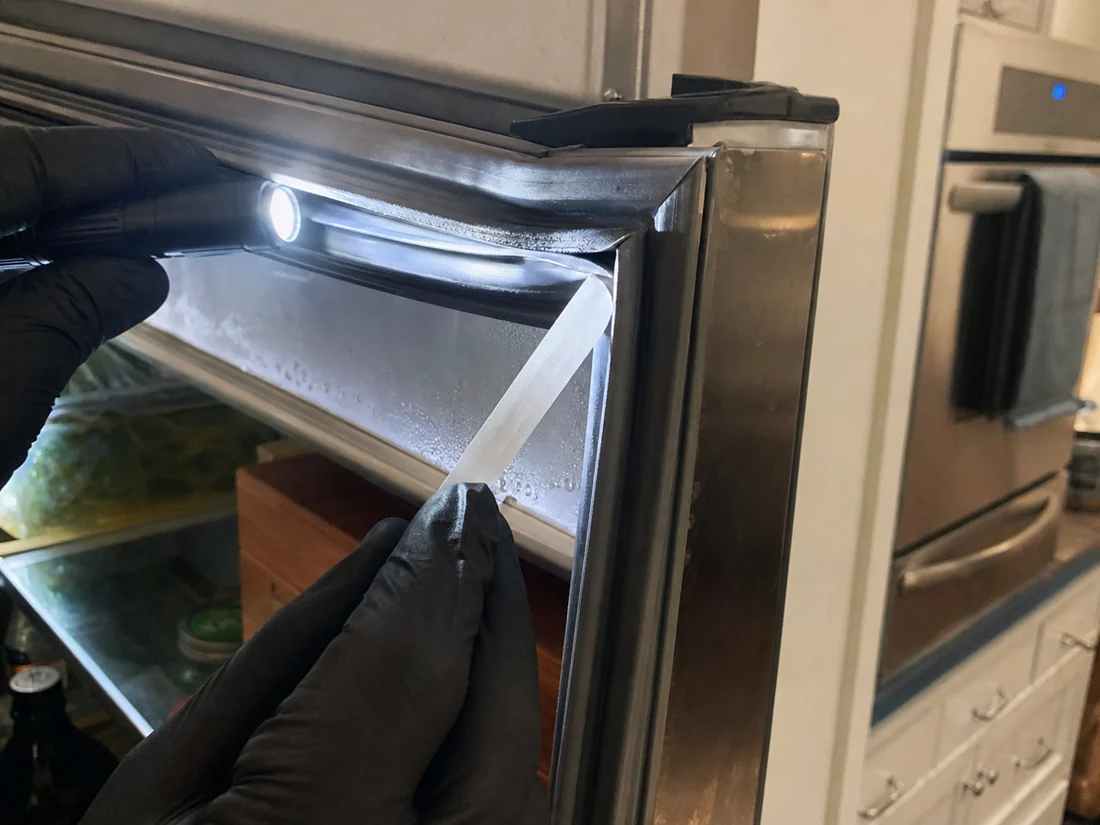
The cause was a hardened gasket plus a slightly dropped hinge that held one corner open — together enough to move the cabinet a few degrees and sweat the face. No sealed-system work, no compressor. For how a built-in like this is pulled and reseated without harming the millwork, see cabinet-safe built-in service; for the broader picture, the Sub-Zero repair overview lays out every cold-side family we cover.
Morgan Hill extractable facts for door gasket and seal repair
Citation-ready local range
Typical frost line, sweating frame, hardened gasket or door that will not close flat work in Morgan Hill is published as $420-$860 for this page's primary scenario, with this timing plan: 1.5-3 hours. The local first check is heat-hardened gasket, hinge sag, panel weight or cabinet racking in Jackson Oaks or nearby 95037/95038 homes.
| Service / symptom | What is included | Price range | Time |
|---|---|---|---|
| door gasket and seal repair / frost line, sweating frame, hardened gasket or door that will not close flat | model and serial check, independent °F readings, access review for panel-ready kitchens near Holiday Lake Estates | $420-$860 | 1.5-3 hours |
| Door seal and paper-strip test | gasket inspection, hinge read and leak mapping | $420-$860 | 1.5-3 hours |
| OEM gasket replacement | serial-matched gasket, heat set and closure test | $430-$845 | 2-3.5 hours |
| Panel-ready door alignment | hinge, reveal and cabinet-rack correction | $270-$665 | 1-3.5 hours |
Final price changes with model, serial range, part availability, cabinet access and measured fault; in Morgan Hill, heat, dust, hard-water or well-water conditions and panel-ready cabinetry often move the quote.
Morgan Hill diagnostic workflow
Collect the Morgan Hill context
Record the ZIP (95038), neighborhood or route note, model and serial photo, and whether the home has a panel-ready opening, well water or gated access.
Read temperatures before parts
Measure fresh-food, freezer and, when relevant, wine-zone temperatures in °F so frost line, sweating frame, hardened gasket or door that will not close flat is separated from a display-only complaint.
Check the local stressor first
Inspect heat-hardened gasket, hinge sag, panel weight or cabinet racking before naming a high-cost part; this is where Morgan Hill heat, dust, water quality and cabinetry change the first test.
Verify the component
Use airflow, meter, pressure, fill-volume or gasket tests on the Sub-Zero magnetic door gasket and match parts to the BI-42, BI-48 or integrated column serial range.
Quote the repair band
Give a written range and time window before work starts, and flag condensation that returns within 24 hours after wiping as the condition that changes urgency.
Topic-specific service proof
Morgan Hill proof notes for door gasket and seal repair
The panel-ready door on our Coyote Estates column wouldn't close flat because of the heavy custom panel. He accounted for the panel weight, adjusted the hinge and fitted the right gasket without racking the cabinet. Clearly knows these integrated installs.
Daniel K. — Coyote EstatesHe used a paper-strip test all the way around the door of our San Martin built-in to show me exactly where the seal had given out. Fitted an OEM gasket matched to the model and the door grips properly now. Simple, honest demonstration of the problem.
Linda S. — San MartinSweating door or frost line? Get it read, not guessed
Call or book online with the seal symptom ready, and we'll keep the Morgan Hill diagnostic window focused on the likely cause before arrival.
Morgan Hill questions about door gasket and seal repair
What makes door gasket and seal repair different in Morgan Hill?
Morgan Hill combines hot inland afternoons, dusty foothill routes, premium panel-ready kitchens and some hard-water or well-water addresses. For frost line, sweating frame, hardened gasket or door that will not close flat, that means the first useful checks are temperatures, airflow, water condition and cabinet access before a part is named.
What price range should I expect for frost line, sweating frame, hardened gasket or door that will not close flat?
For this page's primary scenario, the published Morgan Hill planning range is $420-$860. A related local check often falls in the $420-$860 band. Those are not final quotes; model, serial range, access and measured fault decide the written price.
Which readings should I write down before calling?
Write down fresh-food temperature, freezer temperature, display setpoint, ZIP code, model and serial photo, and whether this urgent condition applies: condensation that returns within 24 hours after wiping. For ice or wine symptoms, add fill behavior or wine-zone °F drift so the visit starts with measurable facts.
Can this be diagnosed without pulling the Sub-Zero magnetic door gasket out?
Often yes. Many door gasket and seal repair checks start from the front: temperature readings, condenser access, door seal checks, fan operation, control history or water fill volume. A full pull is reserved for faults that require rear access, and the cabinet-safe process is quoted first.
When does frost line, sweating frame, hardened gasket or door that will not close flat become urgent?
It becomes urgent when condensation that returns within 24 hours after wiping. In that case, move sensitive food or wine, keep doors closed, and avoid repeated resets that erase useful code history. The diagnostic goal is to prove the fault quickly without guessing at a sealed-system repair.
Why mention neighborhoods like Holiday Lake Estates?
Neighborhood context is practical, not decorative. Holiday Lake Estates can mean different driveway access, cabinet style, dust load, sun exposure or water quality than a flat in-town route. Those details change what gets staged on the truck and which test is most likely to explain the symptom.