
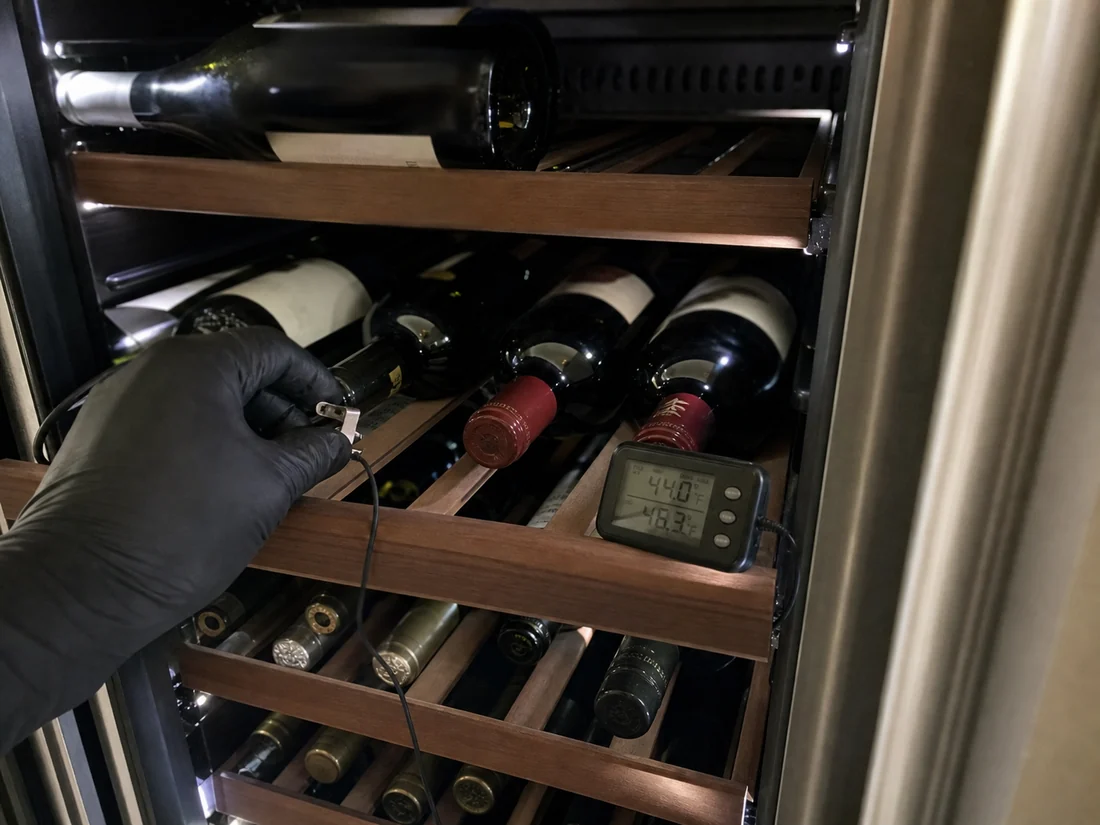
The phone call almost always starts the same way: the display still reads 55, but the reds on the lower shelf feel closer to room temperature, and nobody can say when it started. A Sub-Zero wine cooler is built to hold a number and forget about it, so when it quietly stops holding that number, the cause is rarely obvious from the front of the unit.
In the South Valley we see a particular cluster of wine-cooler faults, shaped by Morgan Hill's hot, dry summers and by where people put these units — built into a kitchen island, tucked into a butler's pantry off the garage, or out at a hillside-estate bar. Here is how a drifting Sub-Zero wine column is actually diagnosed.
Dual-zone control: when one zone lies
Most Sub-Zero wine units are dual-zone — an upper compartment for whites and a lower one for reds, each with its own thermistor and damper. The most common single failure we find is a drifting or dead zone sensor. The control board reads the bad thermistor, believes the zone is already cold, and stops calling for cooling, so that shelf creeps warm while the display still shows the set point. One zone perfect and the other warm is the classic signature, and it points straight at the sensor or its damper rather than the compressor. It is a bounded, genuine-part repair, not a reason to replace the unit.
The sealed system and the fan you can hear
A wine cooler chills through the same kind of sealed refrigeration system as a built-in fridge — compressor, evaporator, and an evaporator fan that moves the cold air across the bottles. When both zones drift warm together, the question moves to that system. A failing evaporator fan, a frosted-over coil, or a slow refrigerant loss all show up as gradual, whole-cabinet warming. We read the actual evaporator and compartment temperatures rather than trusting the front display, because a sealed-system diagnosis is the one place where guessing gets expensive. A noisy or rattling unit, by contrast, is more often a fan or a compressor mount than a true sealed-system problem.
Heat the cooler can't shed
Morgan Hill summers load these units hard. A wine cooler asked to hold 55 in a butler's pantry that bakes to 90 by late afternoon — or worse, a unit set into a garage bar out on the rural lots toward Anderson Lake — is running its condenser flat out. Pack that condenser with the household dust our dry air carries and it can't reject heat, so the whole cabinet drifts warm in the afternoon and recovers overnight. That daily swing is exactly what ages a collection. Clearing the condenser and confirming clear airflow around the grille is the cheapest fix on this list, and it is the first thing we check.
Seals, glass, vibration — and when to replace
The smaller faults matter because the stakes are bottles, not groceries. A tired door gasket or a failing seal on the UV-tinted glass lets our arid summer air leak in, the unit fights to hold humidity, and corks slowly dry. Excess vibration from a worn compressor mount or fan can also disturb sediment in older reds over time. The good news on repair-versus-replace: a Sub-Zero wine unit is built to be serviced. A sensor, a fan, a gasket, even a sealed-system repair is almost always worth doing on a unit that protects a real collection. We diagnose first, show you the live readings, and the $89 service call goes toward the repair — booking is by phone or online, and we are independent, not factory-authorized.